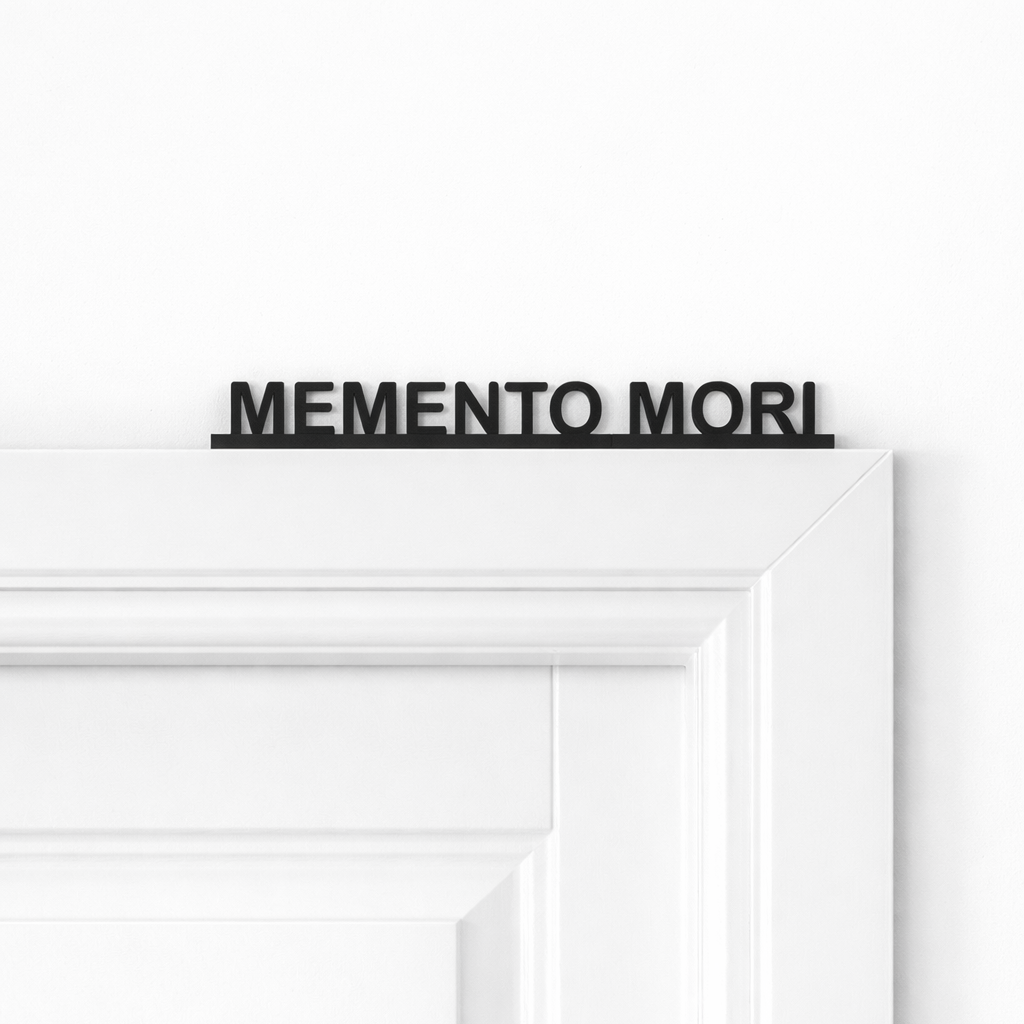
Memento Mori is a Latin phrase meaning "remember you will die" — one of the oldest and most powerful practices in Stoic philosophy. It is not a morbid fixation on death. It is the opposite: a precise tool for living more
fully, more deliberately, and more honestly.
The Stoics understood something counterintuitive: that confronting our mortality — not avoiding it — is what gives urgency and meaning to the present moment. If you truly remember that your time is finite, you stop wasting it on trivialities.
You stop deferring the things that matter. You start living the life you have, rather than the one you imagine you'll have later.
"Let us prepare our minds as if we had come to the very end of life. Let us postpone nothing."
— Seneca, Letters to Lucilius
The Stoic Practice of Memento Mori
The practice appears across every major Stoic thinker. Marcus Aurelius, Emperor of Rome, returned to it constantly in his private journals. He wrote of imagining that each day might be his last — not as an exercise in dread, but as a clarifying
lens. What matters today? What deserves your attention, your energy, your care? Everything else falls away.
Epictetus, who began life as a slave and became one of Rome's most respected philosophers, taught that death is not something to fear — only our judgements about death cause suffering. The thing itself is neutral. What we do with the time
before it is not.
Seneca, in his Letters to Lucilius, wrote entire essays on the subject — urging his readers not to squander the gift of time on distraction, flattery, and ambition without purpose. "Omnia aliena sunt, tempus tantum nostrum est" — everything else belongs to others, only time is truly ours.
"It is not that I have little time; it is that I waste a good deal of it."
— Seneca, On the Shortness of Life
Memento Mori in History
The phrase has roots older than Stoicism itself. In ancient Rome, when a general returned from victory in battle, a slave would stand behind him during the triumph procession and whisper memento mori — remember you will die —
to prevent him from growing too proud. It was a reminder that even at the height of power and glory, mortality was unchanged.
Through the medieval period, the concept pervaded art, architecture, and literature. Skulls carved into doorways and tombstones, hourglasses in paintings, the phrase itself inscribed on rings and sundials. Every generation found its own
way to keep death visible — not to dwell on it, but to be sharpened by it.
Memento Mori Above Your Door
There is perhaps no better place for this reminder than above your door. Every morning you leave — for work, for errands, for another ordinary day — these two words are there. Every evening you return — tired, distracted, preoccupied —
they are still there.
Placing Memento Mori above your door is not about making your home feel heavy or grim. It is about keeping something true in plain sight. The Stoics did not consider this a burden — they considered it a gift. The awareness
of an ending is what makes a beginning worth something.
Your guests will ask about it. Some will be unsettled. Others will understand immediately. Both reactions tell you something worth knowing.
About This Door Topper
The Memento Mori door topper is 3D printed in high-quality PLA, designed to sit cleanly above any standard door frame. Lightweight, durable, and built to last. Created in Switzerland, each piece is inspected before shipping.